Chattanooga, Tennessee
Websites for local businesses that already have the customers.
I build fast, plain sites for shops, studios and trades around Chattanooga — and make sure the tools people now use to find you can actually read them.
Work
Three sites, three trades, one system.
Open any of them. They should load before you have finished tapping, and they should answer the question you actually came with — on a phone, in a parking lot, with one bar of signal.
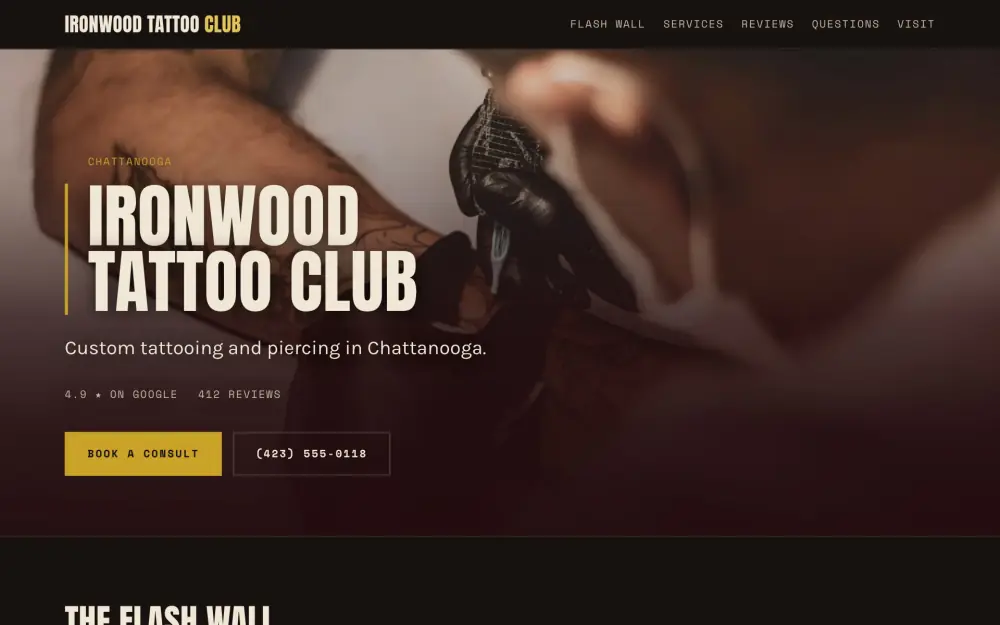
Ironwood Tattoo Club
Tattoo studio
A studio with no photography to show yet. The wall of numbered plates is built to be filled with the artists' own work.
View the demo →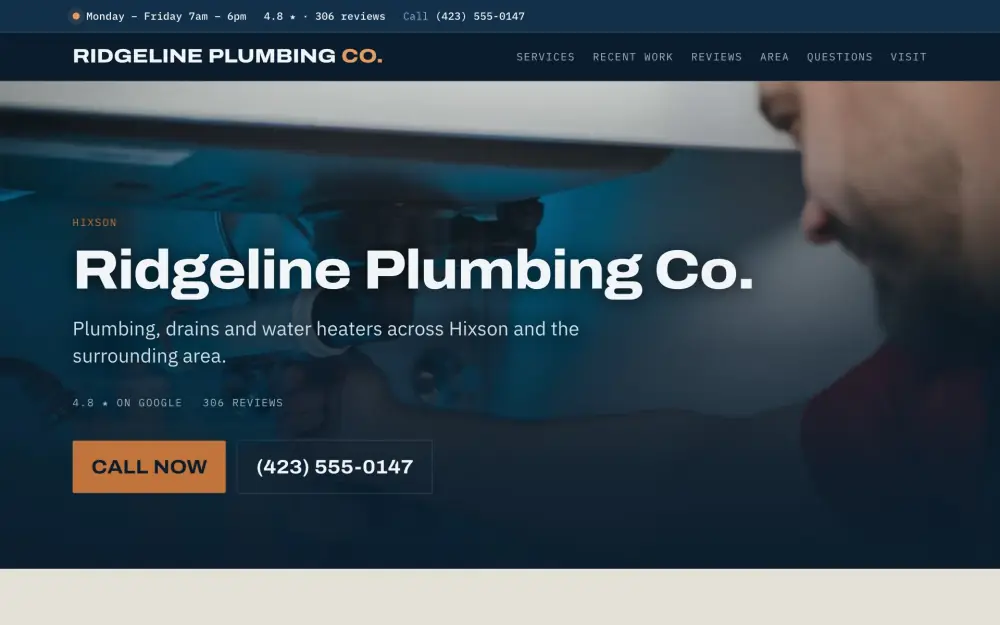
Ridgeline Plumbing Co.
Plumber
For a trade where the customer is often standing in water. Phone first, services second, everything answerable at a glance.
View the demo →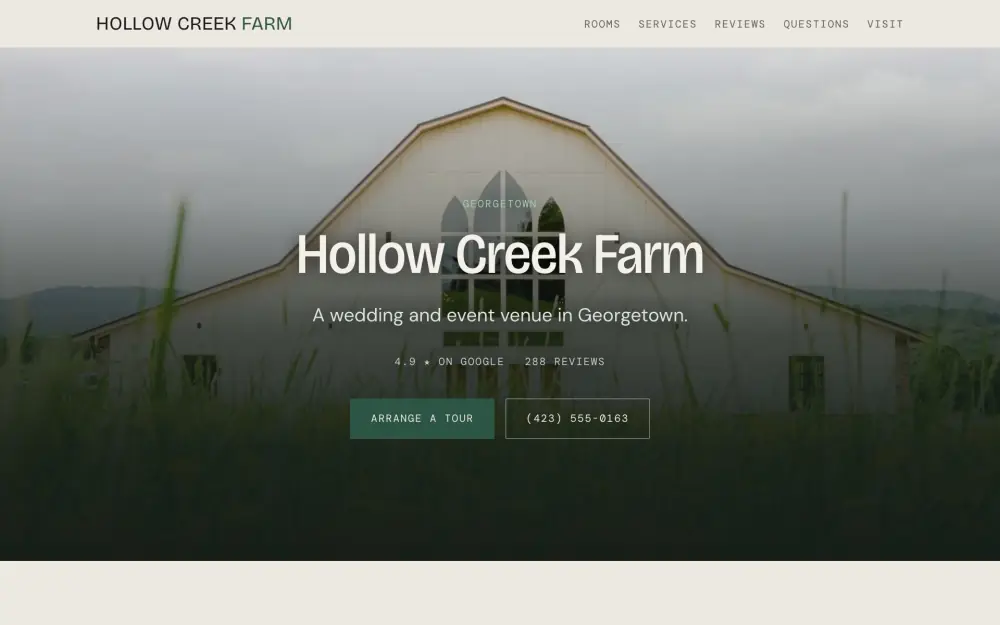
Hollow Creek Farm
Wedding venue
Couples compare six venues on a spreadsheet. This one answers the six questions that decide it, in the order they get asked.
View the demo →These three are demonstrations, not clients. The businesses are invented so that nothing here misrepresents anyone — the names, addresses, phone numbers and reviews are made up. Your site would be built the same way, with your own words and your own photographs.
The problem
What is actually wrong with most local business websites?
They are slow on a phone
Most were built on a page builder that ships a megabyte of JavaScript to show an address and a phone number. On a patchy connection in a parking lot, that is a blank screen.
They answer nothing
A page of adjectives about quality and passion, and nowhere does it say what it costs, whether you take walk-ins, or what happens if it rains. Those are the questions people actually type.
Assistants cannot read them
More people now ask an assistant for a recommendation than scroll a page of blue links. Those tools read plain HTML. If your site is empty until scripts run, they see nothing at all.
AI search
Built to be read by machines as well as people.
When someone asks an assistant for a plumber in Hixson, it reads websites to answer. It does not look at your design. It reads the plain text and the structured data underneath, and it can only repeat what it finds there.
So your site is written and marked up to be found that way: your name, address and phone matching your Google listing exactly, your services named, and the questions your customers actually ask written as headings with real answers under them. Here is what a machine can pull off one of the demo sites.
What nobody can sell you: a guaranteed spot in any assistant's answer. They each choose sources differently and change how they do it. What is in your control is being readable, accurate and consistent — so you are eligible to be quoted rather than invisible.
- Business
- Ridgeline Plumbing Co.
- Type
- Plumber
- Area
- Hixson, Tennessee
- Phone
- (423) 555-0147
- Rating
- 4.8 from 306 reviews
- Services
- Emergency leak and burst pipe repair, drain cleaning, water heater repair, repipe work, sewer line repair
Do you offer 24-hour emergency plumbing?
Emergency calls are taken outside normal hours. Ring (423) 555-0147 — for an active leak, shut the water off at the main before you call.
My water heater is leaking. What do I do?
Turn off the cold water supply valve on top of the heater, then cut the power at the breaker…
What you get
A site that loads instantly and answers the question that was asked.
Built as plain pages
No page builder, no plugin stack, nothing to update at midnight. The whole site is files on a fast network, which is why it opens before you have finished tapping.
Readable by machines as well as people
Structured data, your name, address and phone consistent with your Google listing, and the questions your customers ask written as headings with real answers underneath. That is the part most sites skip.
Booking and payments through tools you own
Square, Calendly, Stripe — set up under your account, in your name, paid to them directly. I do not build these and I do not sit in the middle of your money.
Yours from the first day
The domain is registered in your name on your card. The code lives in your account. If you stop working with me, nothing breaks and nothing needs handing over.
The pieces
What goes on your site.
Every site is assembled from the same set of parts, in the order that suits your trade. A plumber leads with the phone; a tattoo studio leads with the work. Nobody gets all of them.
The opening
Your name, what you do, the town you do it in, and the one button that matters — call, book, or ask for a price.
What you handle
Your services, named the way you say them out loud rather than the way a brochure would.
Your work
A wall of your own photographs. Built to be filled with yours — never stock, never anybody else's.
Proof
Your Google rating and review count, and your reviews in your customers' own words. Quoted, never invented.
Where you work
The towns you actually cover, for the trades where that is the first thing anyone wants to know.
Questions people ask
The questions customers really type, answered plainly. This is the part that gets read back to them by an assistant.
How to reach you
Address, hours, and booking or quote requests through a tool in your own account.
Pricing
Fixed price, agreed in writing before anything starts.
Half up front, the balance before the site goes live. If the scope changes, you get a new number before the work happens, not after.
Starter
A single page that does the job: what you do, where you are, how to reach you, and the questions people ask. Right for a shop that has nothing at all, or a page that embarrasses you.
Standard
Several pages, a gallery of your own photographs, and booking or quote requests wired to the tools you already use. Right for most trades and studios.
Commerce
Everything above, plus selling online — products, deposits or gift cards, through a payment account in your name.
Optional care plan, $99 a month: monitoring, security updates, backups, and up to half an hour of content changes. Cancel whenever you like and you keep everything.
Questions people ask
Straight answers, including the ones that cost me work.
How much does a website cost?
$1,500, $2,500 or $4,000 depending on how much site you need. You get the number in writing before anything starts, and it does not move unless you change the scope.
How long does it take?
Most builds run two to four weeks. The slow part is almost always waiting on photographs and the details only you know, so the more of that you have ready, the faster it goes.
Can you guarantee I will show up in ChatGPT?
No, and be careful with anyone who says they can. Assistants pick sources differently from each other and change how they do it. What I can do is make sure your site is readable, accurate and consistent with your listings, so you are eligible to be quoted rather than invisible.
Do I own the site, or are you renting it to me?
You own it. Domain in your name, code in your account, third-party services under your email. The care plan is optional and cancelling it does not take anything away from you.
What is AI search optimisation, and do I need it?
It means writing and marking up a site so an assistant can read your business and quote it correctly. Most of what gets sold under that name is filler. The parts that hold up are plain HTML, consistent contact details, and pages that answer real questions — and they are included, not an extra line on the invoice.
Do you write the words and take the photographs?
I write the words with you, from a conversation rather than a questionnaire. Photographs are yours: your own, or licensed stock you have approved. I will not put another business's pictures on your site.
Contact
Tell me what you have and what is wrong with it.
Email is easiest. Say what the business is and what you want the site to do, and you will get a straight answer about whether I am the right person for it — sometimes I am not.
- [email protected]
- Phone
- (423) 400-6708
- Area
- Chattanooga and Hamilton County, Tennessee
- Hours
- Monday to Friday, 9am to 5pm Eastern